French Drains
Collect subsurface water and move it toward an appropriate discharge point.
Exterior water-management solutions
We identify how water enters, collects and travels across your property—then build a practical drainage plan around the actual site conditions.
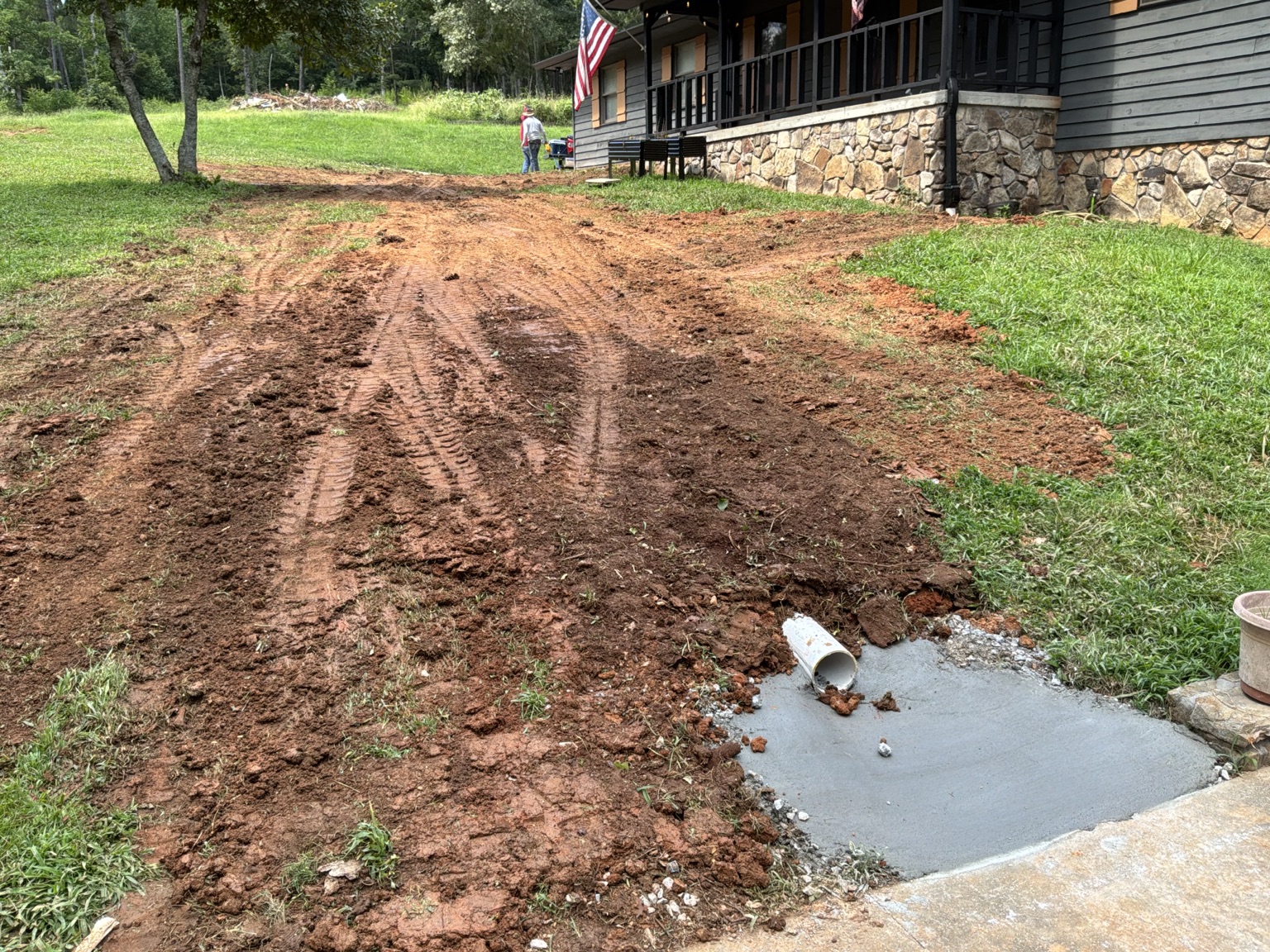
Real project conditions
Photos, elevations and an on-site evaluation help separate surface runoff, roof water and grading problems before excavation begins.
Diagnose before digging
Drainage problems can come from roof runoff, surrounding grades, compacted soil, uphill properties, driveways or several sources working together. A drain installed in the wrong place can miss the water entirely.
We look at collection points, elevation, slope, outlet options and the surrounding property before recommending a repair.
Drainage capabilities
Some projects need one focused correction. Others work best as a connected system that collects, carries and safely discharges water.
Collect subsurface water and move it toward an appropriate discharge point.
Capture surface water in low areas before it spreads across lawns, drives or structures.
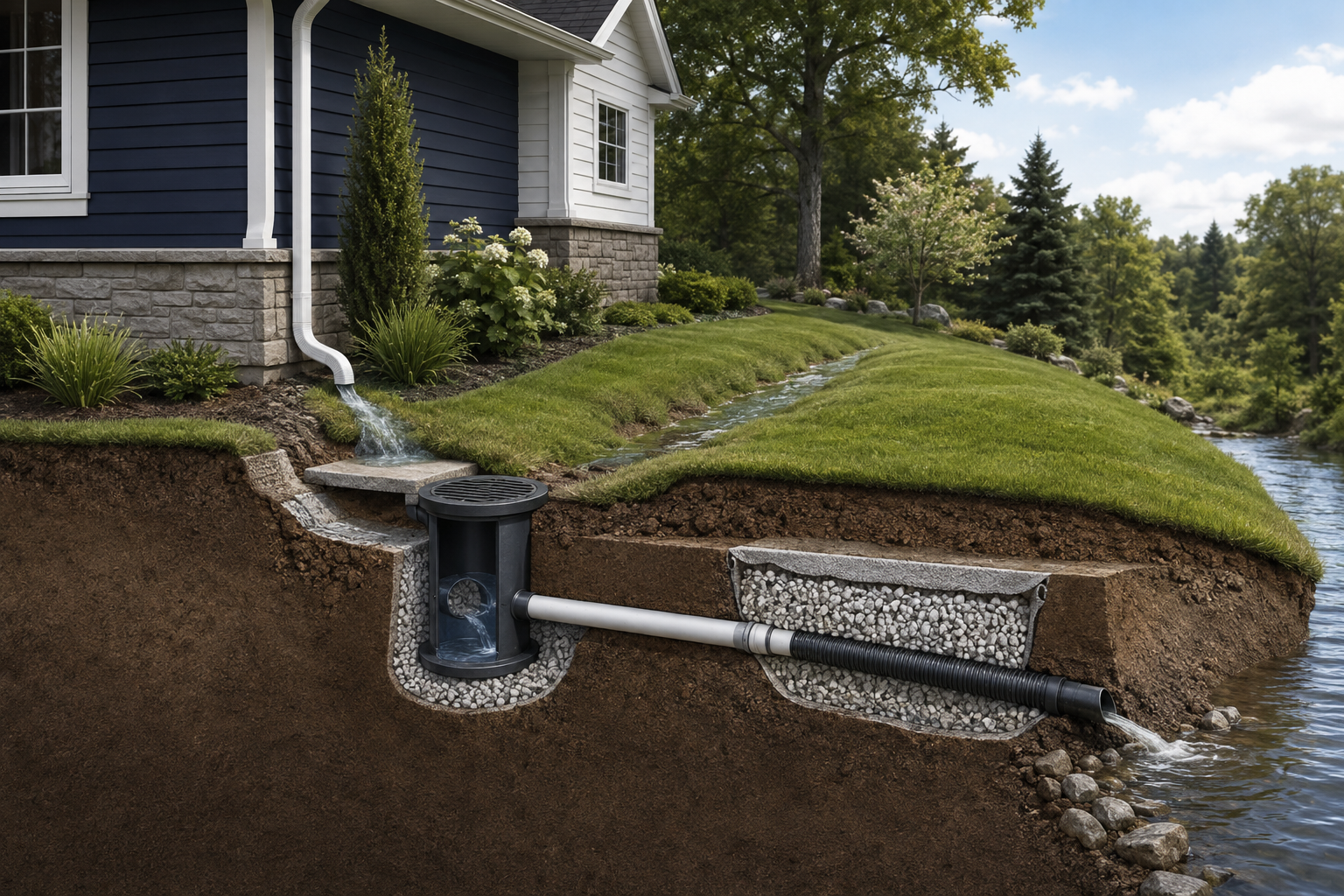
Carry roof runoff away from foundations and high-traffic areas through solid pipe.
Intercept fast-moving surface water across driveways, patios and commercial pavement.
Reshape the surface to create positive drainage and guide water in a controlled direction.
Stabilize outlets and vulnerable areas with grading, stone and other site-appropriate methods.
Our process
We avoid one-size-fits-all recommendations. The route, pipe, collection points, slope and outlet all have to work together.
We review where water appears, when it happens and what areas are being affected.
We inspect elevations, runoff sources, soil conditions, access and possible discharge locations.
We select the collection, conveyance, grading and stabilization methods suited to the property.
Utilities are addressed as required, the system is installed, and disturbed areas receive a practical final cleanup.
Residential drainage
We help homeowners address water near foundations, soggy lawns, roof runoff, eroding slopes, washed-out landscaping and driveway drainage.
Commercial drainage
Select solutions for parking areas, loading zones, walkways and commercial sites—including trench drains, catch basins and larger conveyance systems.
Project work & planning visuals
Real JM Precision project photos are identified as actual work. Illustrations explain how the recommended systems and structures fit together.
Drainage FAQs
Every property is different, but these are some of the questions we hear most often.
The right solution depends on where the water originates, how it crosses the property, soil conditions, available fall and where the water can discharge. We evaluate those conditions before recommending a system.
Yes. We install French drains when subsurface water collection is appropriate, along with catch basins, solid drain lines, downspout connections, trench drains and graded swales.
Often, yes. Depending on the cause, the solution may involve roof-water routing, surface grading, collection basins or another exterior drainage method. We do not present every water problem as a French-drain problem.
Yes. We evaluate select commercial drainage projects, including parking-lot runoff, loading areas, trench drains, catch basins and controlled discharge systems.
JM Precision will contact 811 before excavation when the planned work requires utility locating. Private utilities and customer-installed lines may require separate locating.
The outlet must be practical, stable and appropriate for the property. We look for adequate fall and a location that does not create a new problem for structures, neighboring property, drives or walkways.
Yes. Roof water can often be carried through solid pipe to an appropriate outlet. Downspout lines are planned separately from perforated French-drain pipe so roof runoff is moved efficiently.
No. French drains collect subsurface water, but standing water may instead require surface grading, catch basins, downspout routing or a connected system. We recommend the method that matches the water source.
Yes, when the existing system can be accessed and a repair is practical. We can investigate clogged, damaged, poorly routed or ineffective components and explain whether repair or replacement makes more sense.
Yes. Diverting runoff, restoring roadside flow and controlling discharge can reduce washouts and potholes. Drainage and driveway shaping often need to be planned together for a lasting repair.
Start with what you’re seeing
Tell us where water is collecting, when it happens and what it is affecting. Photos or video are especially helpful.
If the form does not appear, open the secure request form in a new window.